Growing Up Female: On Nonexistence

Rebecca Solnit’s new memoir Recollections of My Nonexistence resembles her many essay collections that came before it: provocative yet relatively opaque. She weaves ideas together, creates surprising connections, and guides readers to see their experiences in new ways (a la “Men Explain Things to Me”) — but she does not delve into personal details. Unlike other contemporary memoirists, she writes towards commonality. Through brief vignettes that begin with her own experiences as a young woman, she reveals the conditional of all young woman. She makes us visible to ourselves.
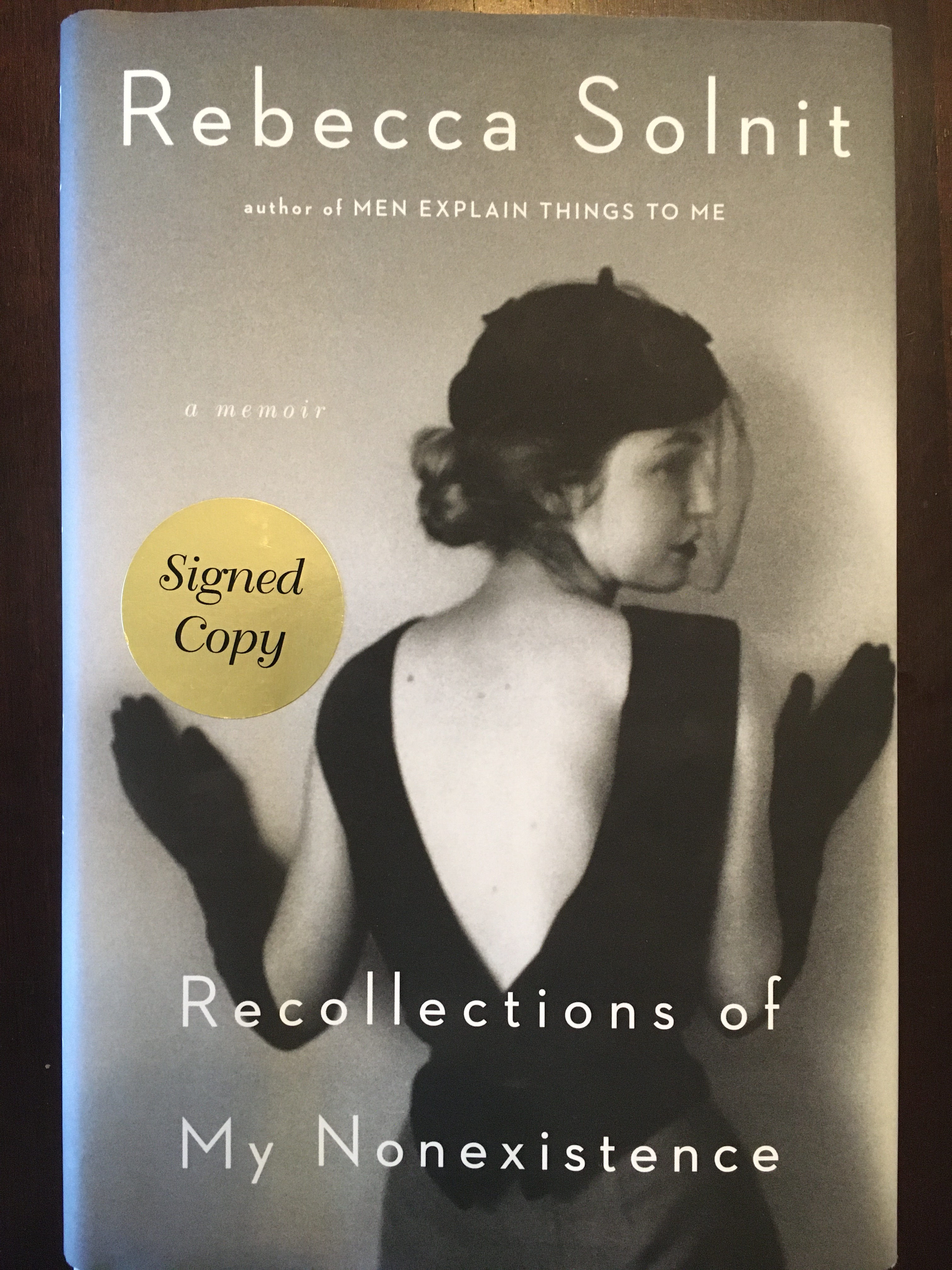
Thanks to Subterranean Books in Saint Louis, MO for shipping books during quarantine 🙂

As a reader and 26-year-old woman, I found this book hard to read — but not for the usual reasons. Solnit pushes right up to the edge of Emily Dickinson’s advice that “the truth must dazzle gradually.” Many of her conclusions felt like looking into direct sunlight. In a way, I need to write this review to process that initial sting.

Though her memoir collection also includes essays writes about growing up in San Francisco, studying the southwestern U.S., and becoming a writer, Solnit’s most powerful chapters meditate on feminism, i.e. growing up female. She uses the titular word “nonexistence” because “in my case, it wasn’t a silencing. . . no speech was stopped; it never started, or it had been stopped so far back I don’t remember how it happened.” Her goal, she states, is encouragement: “a word that, though it carries the stigma of niceness, literally means to instill courage.” To do so, she begins by examining how courage is ripped away from young women. She then discusses how they might go about getting it back.

Solnit’s careful recounting of her past nonexistence (in “silent fury”) shed new light on my own. I’ll explore a few such instances here.

“I became an expert at fading and slipping and sneaking away, backing off, squirming out of tight situations, dodging unwanted hugs and kisses and hands, at taking up less and less space on the bus as yet another man spread into my seat, at gradually disengaging, or suddenly absenting myself.”

“Life During Wartime”

For me, passages such as these yank to the surface a decade-long pattern of suffering under patriarchy, but not understanding what was happening to me, or knowing what to call it. Solnit’s words brought up so many memories; memories that make me sweaty and nervous; memories that make me sad about the state of the world; memories that, despite my efforts to bury them, inform the way I move through the world.

“Dodging unwanted hugs and kisses,” takes me back to my first job out of college as an executive assistant to a 69-year-old lawyer, a founding partner at a Chicago law firm and real estate attorney for one of the world’s richest men. He would ask me to dinner with business partners, take me out for drinks in the afternoon (“You’ve never had mezcal? I’m ordering it for you”), put his arm around me, ask me why I wasn’t having fun, try to kiss me in greeting (he got the cheek), tell me I was attractive, and make sex jokes to his coworkers, knowing part of my job was to listen to all of his phone calls and read all of his emails.

In response to this treatment, I, to my own frustration, did nothing but comply and evade. “Okay I’ll drink that,” “yeah I’m fine,” “haha,” “okay,” just get through the day and get out. I vented to my friends, where it was safe, but never to him. As Solnit describes, evasiveness stems from a fear of escalation. Escalation leads to violence. She writes, “Men would make proposals, demands, endeavor to strike up conversations and the endeavors quickly turned to fury. I knew of no way to say No, I’m not interested, that would not be inflammatory, and so there was nothing to say. They was no work words could do for me, and so I had no words.”

Eventually, I gave my boss what it seemed he wanted: I vanished. I packed my things and called him to let him know that I was quitting. To him, it was a shock; to me, it was the natural conclusion of his year-long effort to annihilate my personhood. That was in August 2017. When the Harvey Weinstein story broke two months later, I believed for the first time that I had done the right thing. (And considered that maybe I should’ve gone to HR, or Ronan Farrow – but that’s another story.)

“I erased myself as much as possible, because to be was to be a target.”

“Life During Wartime”

Maybe it started earlier than a decade ago. As a 10-year-old in Boise, Idaho, I took a Hunter’s Safety class with my dad, my friend Austyn, and her dad. Austyn’s dad was an avid hunter who wanted to take us duck hunting with him that season. I was game for anything – I just wanted to hang out with my buddy, even if the activity did not particularly appeal to me. The rest of the class was full of other young boys and their dads. One evening, as I remember it, the teacher called on me to answer what turned out to be a trick question. My hand had not been raised. He said, “You there.” I snapped to attention, the blood rushing to my face. “What’s the difference between bending the law and breaking the law?” I quietly began to stumble through some explanation of how the two might be different, but the teacher interrupted. “Wrong, he said, “there’s no difference.” Then another kid’s dad shouted: “Women, am I right?!” and the whole room cracked up.

I took away a feeling that it was dangerous to speak; that I lacked knowledge because of my gender; and that men only listened to me insofar as it gave them an opportunity to appear superior, or to make other men laugh.

“Thinness is a literal armor against being reproached for being soft, a word that means both yielding, cushiony flesh and the moral weakness that comes from being undisciplined. And from consuming food and taking up space.”

“Disappearing Acts”

Around 16-years-old, when my body started shape-shifting, I was horrified to be losing the one thing I had long been praised for — being skinny. When I tried to regain control of my body, I tripped some internal brain wiring and fell into the obsessive hamster wheel of an eating disorder. I went from 120 ish pounds to 96, eating with rigidity and running every day. I stopped caring about boys, about friends, about what people thought of me – which in a dissociative way, felt like freedom. But as my condition deteriorated, I realized it was a dark kind of freedom. When I began to fight against it almost a year later, it was because I began to understand that life had moved on without me – sports, friends, boys, prom etc. I had wholeheartedly embraced nonexistence, only to find that nonexistence did not lead to societal acceptance, but to a lonely death.

“And so there I was where so many young woman were, trying to locate ourselves somewhere between being disdained or shut out for being unattractive and being menaced or resented for being attractive . . . trying to find some impossible balance of being desirable to those we desired and being safe from those we did not.”

“Disappearing Acts”

Most of the compliments about my thinness (and disparaging comments about other girls’ thickening, maturing bodies) came from a grade school friend who later came out as gay. I still remember him telling me that I was pretty “because you are skinny” and that other friends were losing their edge for “fat thighs,” “mom butt,” or “grandma butt.” He called my best friend a “butterface” (i.e. everything looks good but her face). I have no idea how he’d explain himself now, but I imagine that it was a way of processing his own sexuality; of coming to realize that he did not desire women’s bodies, and, taking full advantage of his power as a white male, used his voice to disparage and reject them. As Solnit says, within patriarchy “no [woman] is ever beautiful enough, and everyone is free to judge you.”

It’s a hard truth that in my own experience, the harshest judges were men who felt disempowered themselves – gay men, awkward men, short men, etc. Men whose fathers talked about women disparagingly inherited their menace. It all rained down on the teenage girls in my middle school and high school. And it shaped how we entered the adult world.

“There was a real joy in the creative and intellectual life, but also a withdrawal from all other reals of life. I was like an army that had retreated to its last citadel, which in my case was my mind.”

“Disappearing Acts”
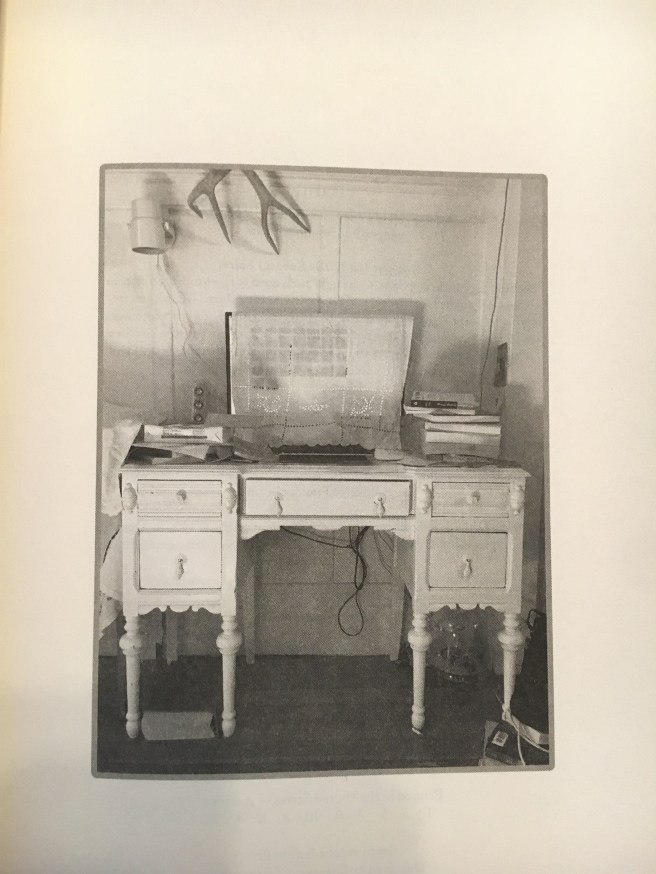
Solnit’s writing desk, given to her by a friend who had been stabbed 15 times by a violent ex-boyfriend. She writes, “Someone tried to silence her. Then she gave me a platform for my voice. Now I wonder if everything I have ever written is a counterweight to that attempt to reduce a young woman to nothing.”

Like Solnit, one of the only places I ever felt confident was in academia. Reading, writing, twirling ideas around my mind like a strand of hair around my index finger. If I am smart, so went my thinking, at least I have somewhere from which to draw courage. And writing was a place where I could say what I was thinking and feeling without fear of upsetting men — in other words, without fear of escalation.

Solnit’s greatest gift to me, and to all women, is finding the courage to become a writer (“despite it all”), and to hold fast to her perspective. She gives young women permission to question the literary and cultural canon, to investigate the untold impacts, and to push for change. She points out how many stories – told in books, on TV, in movie theaters, on podcasts, and in music feature the abuse, torture, and death of young women. Solnit observes this reality and its impact without agreeing that any of this (Tarantino, Eminem, The Ted Bundy Tapes) are productive, revolutionary, or attention-worthy works of art despite their commercial success. For me, that is a powerful permission to stand firm in my aversion to violent “art,” and to call it what it is: mundane.

In addition, Solnit gives herself (and everyone else), permission to put down canonical literary works that subjugate women, such as On the Road by Jack Kerouac:


“I did like some things bout Kerouac’s prose style, just not the gender politics of the three men who were most often meant when people talked about the Beats. . . It seemed to me that I would never be the footloose protagonist, that I was closer to the young Latina on the California farm who gets left behind, and halfway through I put the novel down. The book was going to go on without people like me, and I would go on without it.”

“Diving into the Wreck”

I’d recommend Recollections of My Nonexistence to any and every young woman, with the caveat that it’s not easy to read. But as Solnit herself says, “Sometimes when you are devastated you want not a reprieve but a mirror of your condition or a reminder that you are not alone in it.” Solnit reminds me of this, and makes my experiences, my painful memories, less personal. It’s not my fault that I was taught to be skinny and silent, and that I then became my own oppressor. It’s not my fault that my efforts to push back against the system that annihilates women — efforts such as not wearing makeup, not shaving my body hair, or not wearing a bra – actually exacerbate my fear and self-consciousness when I enter public spaces. It’s not your fault, either.

I’d also recommend it to men. As Solnit points out, “One of the convenient afflictions of power is a lack of [] imaginative extension. For many men it begins in early childhood, with almost exclusively being given stories with male protagonists.” She continues, “Perhaps there should be another term for never looking through the eyes of others, for something less conscious that even single-consciousness would convey.” I established that I have given permission to put down Kerouac (and DFW) thanks to Solnit. Still, I believe I am the better for knowing, intimately, the male reality — and for being taught (by default) to extend my perspective beyond myself.

It’s not always useful to spend a lot of time thinking about the things that make life hard or unfair. It can lead to despair. (In my case, it has to be followed by episodes of Parks and Rec.) What’s more — as Solnit emphasizes repeatedly, categories of doubly-oppressed women, such as young women of color, young women who are gay, or young women whose growing bodies otherwise deviate from Western beauty ideals, have whole additional systems working to exclude and disregard them. That’s a lot to face down, just to exist as a person every day. I don’t know what to do other than begin trying to take up space — even though it scares me.

For more on the treatment of women in Beat literature, read my earlier blog, “Watching Boys Do Stuff.” Thank you, Rebecca Solnit, for giving me permission to quit the Beats, and all woman-erasing literature put to page before or since. Not only giving me permission to quit, but giving me something encouraging to read instead.
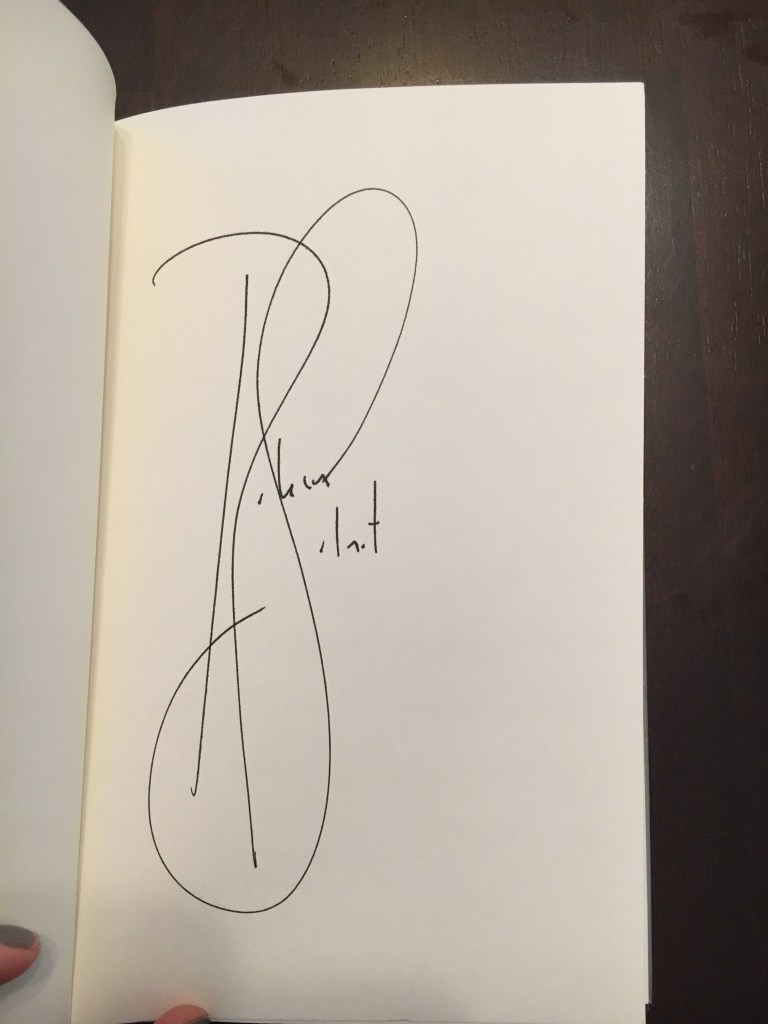
Solnit’s signature: a lesson in taking up space ❤

Rachel Cusk’s Search for Truth

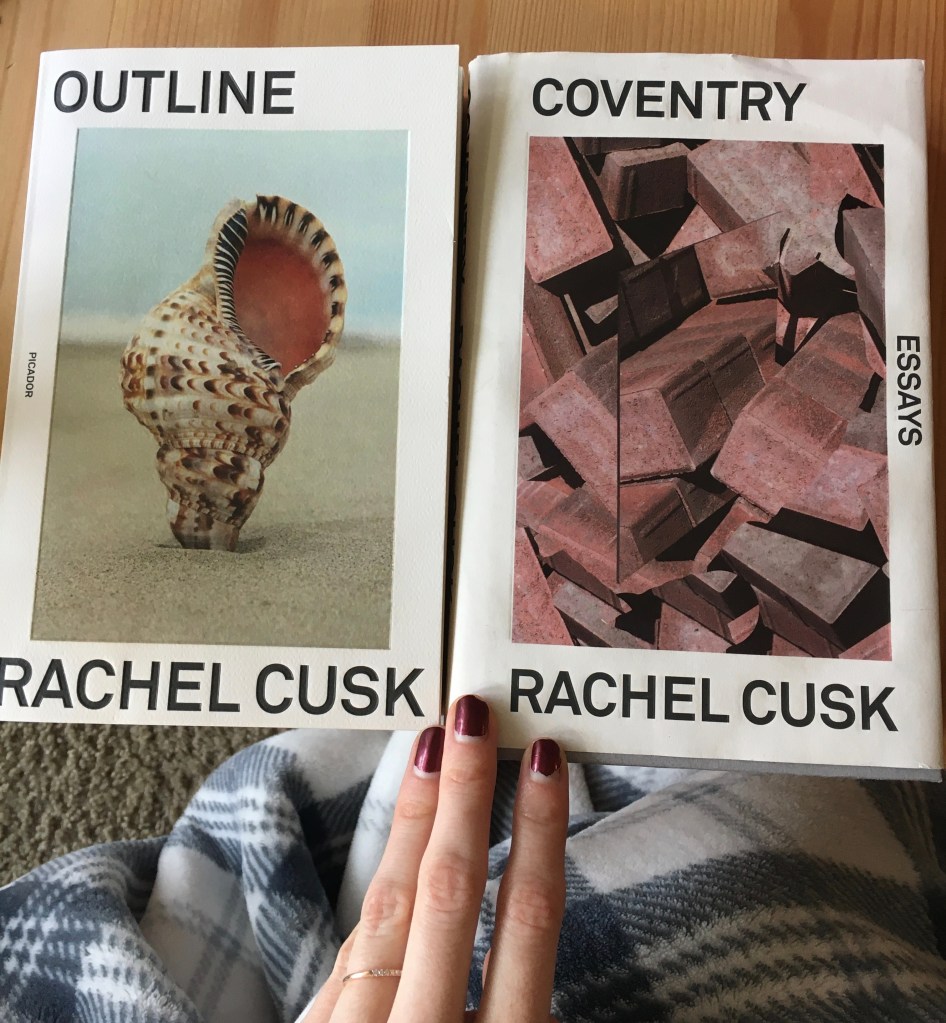
I discovered Rachel Cusk’s Outline trilogy (Outline, Transit, Kudos) last June on some news outlet’s summer reading list. Initially, I borrowed the book from the library, but after reading a couple dozen pages and finding passage after passage I wanted to underline, I capitulated to my desire to mark it up and bought a copy.

In the following passage in the first (and arguably best) novel of the trilogy, Outline, Cusk’s narrator describes the nature of Truth in terms of her two children who previously played happily together daily and were now in a constant state of war:

“Their antagonism was in exact proportion to their former harmony, but where the harmony had been timeless and weightless, the antagonism occupied space and time. The intangible became solid, the visionary was embodied, the private became public: when peace becomes war, when love turns to hatred, something is born into the world, a force of pure mortality. . . Each of them wanted more than anything to be declared right, and the other wrong, but it was impossible to assign blame entirely to either of them. And I realized eventually. . . . that it could never be resolved, not so long as the aim was to establish the truth, for there was no single truth any more, that was the point. There was no longer a shared vision, a shared reality even. Each of them saw things now solely from his own perspective: there was only point of view.”

This excerpt represents Cusk’s main project as an author, as I understand it: to search for captial-t Truth in everything. She asks what conditions Truth requires; she deduces its nature by examining those places where it is absent. She asks her readers to not accept stories at face value, but to accept them insofar as they are True.

For example, in Outline, Cusk’s narrator moves through the world as a spectator and offers herself as a listener. After a character has told Cusk’s narrator his or her story — just when the reader has nearly forgotten there was a character-listener at all — Cusk’s narrator will often challenge the story’s facts and conclusions. For example, after a man seated next to Cusk’s narrator on a flight from London to Athens tells her his life story (unprompted), Cusk’s narrator concludes: “I remained dissatisfied by the story of his second marriage. It lacked objectivity; it relied too heavily on extremes, and the moral properties it ascribed to those extremes were often incorrect.”

In her Coventry essays, Cusk is just as rigorous with herself as a storyteller as her narrator in Outline is with others. For example, in the title essay “Coventry,” Cusk investigates her parents’ use of the silent treatment against her, concluding: “My mother and father seem to believe they are inflicting a terrible loss on me by disappearing from my life. They appear to be wielding power, but I’ve come to understand that their silence is the opposite of power. It is in fact failure, their failure to control the story, their failure to control me.”

However, the next paragraph begins, “But perhaps it isn’t like that at all.” Cusk goes on to consider an entirely different take on what the silent treatment might represent by discussing its employment among middle school girls. She writes: “By sending someone to Coventry you are in a sense positing the idea of their annihilation, asking how the world would look without them in it.” In this sense, the perpetrators of the silent treatment aren’t “like desperate people taking the last of their possessions to the pawnshop” realizing “a failure so profound that all they have left to throw at it is the value of their own selves” (as she first postulated) — but rather they use it to wage a psychological battle against their victim, i.e., “If other people pretend you’re not there, how long can you go on believing you exist?” And both of these ideas are offered by Cusk herself, on the same page.

Thus Cusk demonstrates how multiple perspectives on a single subject can be capital-t True. The second understanding does not undo the first, but rather reveals the first to be incomplete. This is what I love about Cusk’s writing. One of the biggest challenges for me, as someone who likes to write, is constant self-doubt and ever-evolving understanding of the world, myself, and the stories that make up both. If I decide upon one version of events and their meaning one day, but the next alter it completely – what do I do with that first understanding? Erase it? But how would I have landed at the second without the first? And now, what about a third perspective that hits me tomorrow? How do I ever write anything at all, if my understanding of the world is always changing – if the shape and color of Truth keeps changing within my grasp?

As a reader and writer, I find Truth not only in how Cusk sees the world, but in how she reveals her thinking and writing process. Her stories all contain a writer’s journey of postulating, doubting, re-forming, doubting again, and landing at what can only ever be temporary conclusions. Rather than begin at the end – with a single idea – she reveals how her thinking process begins, builds, partly undoes itself, then builds again. There is no certainty in any conclusion – only in the joy of the continued search.

One of my favorite examples is Cusk’s sharp vision is her description of Walt Disney World in her essay “Lions on Leashes.” She describes Disney as a “world where wish fulfillment had become a moral good yet whose ultimate desire was to obscure the truth.”

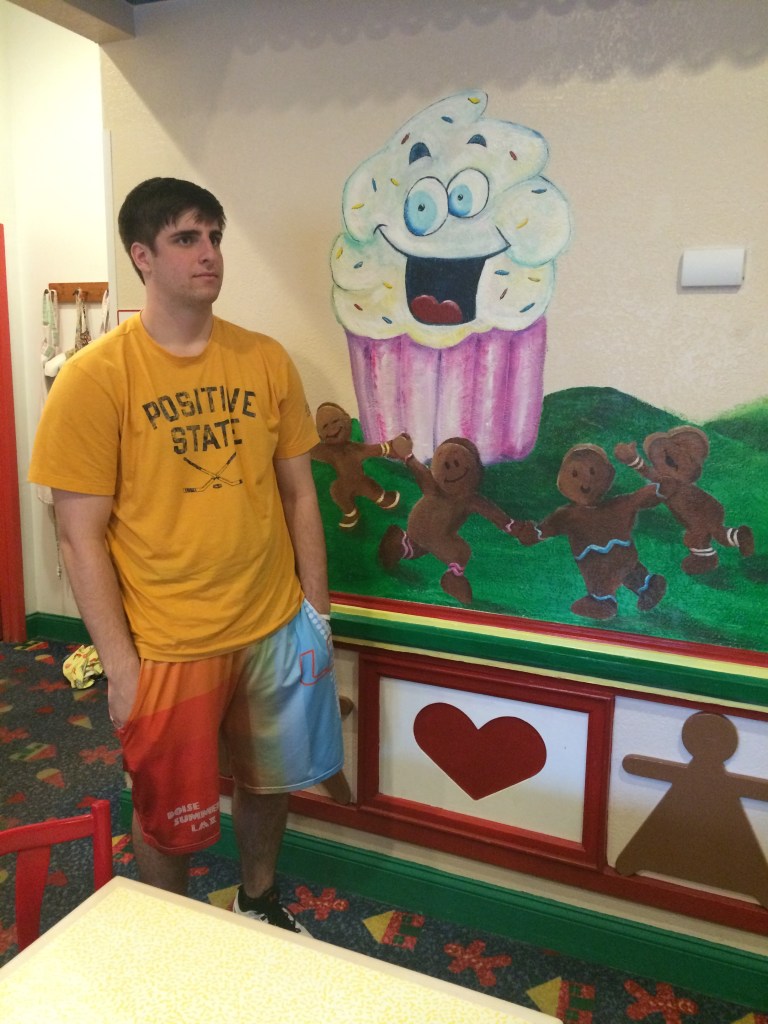
This image of Disney World reminded me of my family’s Make-a-Wish week-long trip there in the summer of 2015. As a Make-a-Wish family, we were put up in a “village” for a week called Give Kids the World with other Make-a-Wish families. To me, a cynical 21-year-old jet-lagged after a semester studying abroad in London, it felt like a Candy Land board come to life — or like that dystopian episode of Sesame Street where Elmo wishes it were Christmas every day. At Give Kids the World, Santa and the Easter Bunny come every day and will even tuck you in at night (unless that idea is terrifying to you – as it was to my brother Michael). A Wish Kid, as well as his or her parents and his or her college-aged siblings, can order free pizza and ice cream at any time of the day, go on free fair rides, eat unlimited amounts of dining hall food (at the Gingerbread Palace), swim in the pool, fish in the ever-stocked pond, etc. Fun all day, every day – at least, of the material variety.

Is this not a life-sized Candy Land? Image from https://www.gktw.org/about/

The confluence of this colorful, material dream-world with the terminally ill kids it housed was shocking, at least to me. As we rode a golf cart from the Welcome Center to our house on the first day, I saw kids on all kinds of medical machinery being wheeled around under giant Disney sculptures by tired-looking parents. Michael seemed to have no idea of anything particularly exciting in these surreal surroundings, but was excited that our family was together. My brother David and I ordered free ice cream and pizza (not things Michael could enjoy, due to his specialized medically-necessary diet), reluctantly interacting with the overly-cheerful volunteers. As Cusk wrote, “wish fulfillment had become a moral good whose ultimate desire was to obscure the truth,” and yet “the truth had stubbornly continued to insist on itself.”

My memory of our week at Give Kids the World has haunted me for a long time. Why did I hate that place so much? Why is my view of the thing so bleak? The rest of my family did not react even close to as strongly as I did. But now my newfound Cuskian understanding of storytelling and searching comforts me. It’s not that the first version of the story (that Give Kids the World sucks and everything is fake) is not true, but that there remains a perspective by which I can drop deeper into the truth – i.e. move towards captial-T truth. Cusk, rather than trying to make the reader question him or herself, works to make the reader comfortable with uncertainty as a necessary part of the journey to truth.

So maybe it was not like that at all. Maybe Give Kids the World is True for the people it was made to serve – terminally and/or chronically ill children. Kids who only see Santa as Santa – even if he’s played by a different leather-skinned retiree every night. Its goal is not to obscure the truth, but to dare to believe entirely in a child’s perspective of it. And perhaps the experience of college-age Make-a-Wish siblings secretly making fun of the place all week long is an added joy of such an earnest commitment. I don’t know. Maybe I’ll write something else tomorrow. As Cusk says, “A desire to write is a desire to live more honestly through language.”

David meets the Muffin Man.
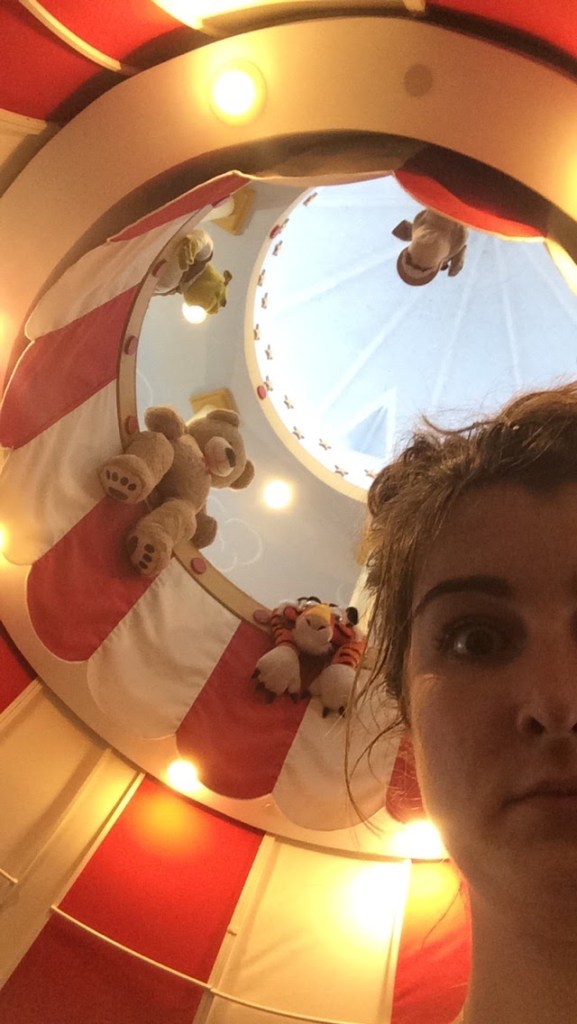
Shrek characters watch from above in the House of Hearts.

A Miss for Patti Smith: My Thoughts on “Year of the Monkey”

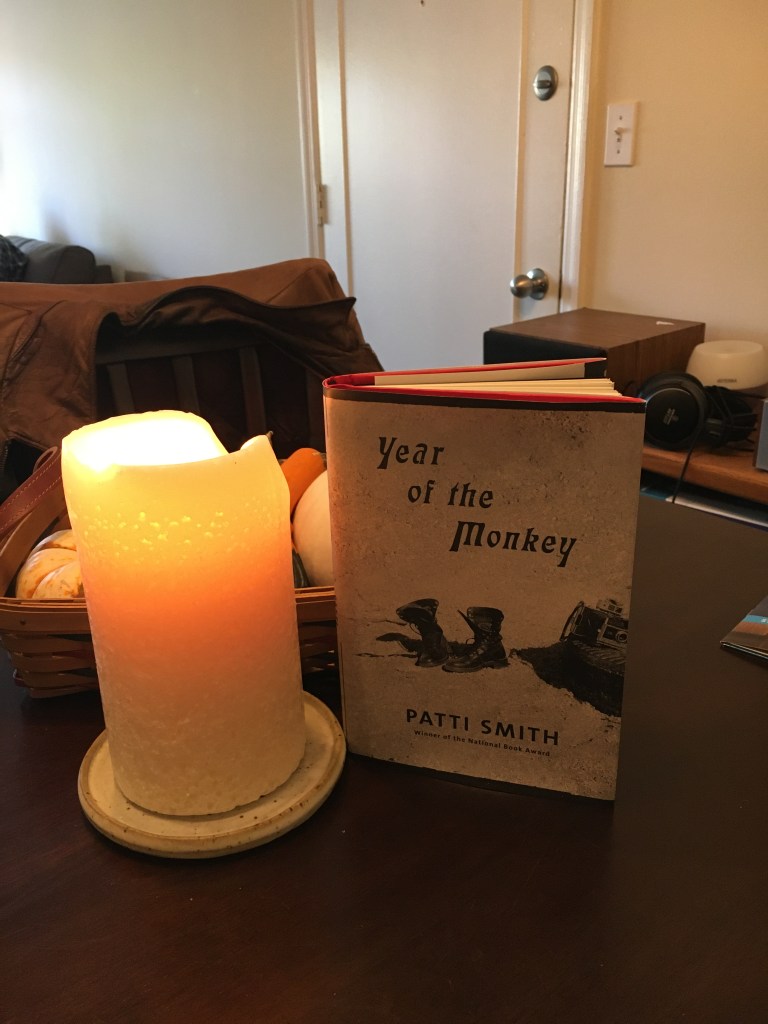
Year of the Monkey is Patti Smith’s third full-length memoir. The book came out last month but the story takes place in 2016. Thom snagged it for me as a birthday present because (a) he knows I love Patti and (b) before we knew each other well, he used to say “Happy Birthday,” instead of “Hi” every time we saw each other, and when I lodged a complaint approximately 4 months in, he switched to “Happy Year of the Monkey.” And now we’re getting married.

I hate to say it, but I didn’t like this one. (Still, it was the perfect birthday present @Thom.) I underlined one good line (to follow), but I had a hard time staying invested and interested.

I deeply enjoyed her previous memoirs Just Kids, M Train, and even Devotion (Why I Write). I also find her photographs and style inspiring and even used to have a prominently displayed poster of her in my apartment. But along the way, I have come across a few of pieces that have not captured me – e.g. most of her music and a lot of her poetry.

So it’s not entirely shocking that a memoir finally fell into the latter category. But first, a few things I did like:

The element of Patti’s memoir style that keeps me coming back is her way of living and thinking like a monk. M Train, for example, was mostly scenes of her walking down the street, drinking vats of 7/11 coffee, strolling back to her house, and watching cable news in bed. She zooms in on these little things, creates a sensory space for the reader, and is not at all anxious or self-conscious. I find these passages relaxing, and almost too weird (too good?) to be true, so I keep reading. An aging, successful artist who takes the same foam cup back to 7/11 every day for 16 oz burnt coffee refills? Puzzling, yet wholesome.

She puts this concept into words halfway through Year of the Monkey: “All is but an intermission, of small and tender consequence.”

It’s the opposite sentiment of Shakespeare’s “All the world’s a stage, and all the men and women merely players;” or the darker Macbeth version: “Life’s but a walking shadow, a poor player, that struts and frets his hour upon the stage, and then is heard no more.”

In contrast to Billy the Shake’s distressing picture of the pressure on each of us to perform as we move through the world, Patti’s philosophy of life is a major relief. The spiritual isn’t found in creation and achievement, but rather in getting stale M&M’s from a vending machine during Romeo and Juliet’s intermission. She does not spell out what she’s doing here (the above sentence is the closest she comes); instead she just dives in. Her faith in the value of these small moments calls the reader to buy in and see these daily sensory experiences with new reverence.

Yet Patti can’t entirely get away with this attitude towards life, because she’s a career stage performer. She is currently performing live perhaps more than she has in several decades. Now 73 years old, she has become wildly popular among a new generation of young people and is publishing a book every two years. But she doesn’t acknowledge any of this change. In Year of The Monkey, where her late-stage success was presumably most prevalent – she alludes to it least of all, never going further than explaining that she’s in X city because she played a series of concerts there Y days earlier.

Moreover, Patti executes the aforementioned concept (“all is but an intermission, of small and tender consequence”) much better in her earlier memoir, M Train than she does in Year of the Monkey. In this new book, Patti oscillates between dreams and reality in a way that’s hard to track and ultimately not that interesting. For example, one scene opens with her sitting on a porch near a beach in Santa Cruz, looking at the waves, feeling the wind, putting up her sore feet, etc. – but quickly shifts and becomes an imagined conversation with a motel sign and hallucination of thousands of misprinted candy wrappers on the beach. I wished she would not keep introducing the latter element. I find the small moments more affecting without the accompanying visions – probably because that is the less-universal part of being Patti Smith.

Furthermore, to put it crudely, all of the real friends she writes about in the book all have one foot (or both) in the grave. That her world was contained to either small sensory moments alone, or imagined, chronically ill, comatose, and dead companions made the whole reading exercise kind of lonely and sad. I wanted more grounded human interaction – and I know it must exist, because she has a band, living kids, and tons of fans.

Maybe she wants to hold onto the vagabond, bizarre parts of herself by describing dreams and (imagined?) hitchhiking experiences and voices in her head. But I can’t help but think there’s some important element of her life missing from this picture. The narrative almost struck me as dishonest – as if her new audience/platform hasn’t changed her days or thought patterns at all. As if this new life was not perhaps responsible for her increasing loneliness. I think she could add some such reflection without losing her artistic center. In any case, I’ll keep an eye on her because, despite it all, I remain her devoted reader.

~~~

Thanks for reading! I’ve read dozens of books since I last blogged… but not everything inspires a type-athon. I will be writing reviews more regularly now that I’ve got some unstructured time this winter. ❤

“Watching Boys Do Stuff”: Joyce Johnson’s Minor Characters

I recently came across Joyce Johnson’s 1983 book Minor Characters on a Goodreads list of memoirs by women, and I was intrigued to find a female voice from the Beat Generation.

At first, it seemed too good to be true. I hadn’t heard of a female writer among the Beats, even when studying them in college courses. After all, most Beat criticism quotes the following observation from Allen Ginsberg: “The social organization which is most true of itself to the artist is the boy gang.” So who was Joyce Johnson? Would her book have literary merit, or would it be a just-okay read, piggybacking off of Kerouac’s celebrity?

Johnson’s cover features the original photo used in a 1993 Gap ad “Kerouac wore khakis.” As one can see, her figure was gently erased.

Speaking for herself, Johnson is almost unrecognizable as a Beat woman. Whereas in On the Road, et al., the women are all legs and beds – sirens of small towns, briefly featured, ultimately discarded – Johnson is a Barnard graduate and aspiring writer, living in New York City. She holds jobs at various literary agencies, gets a book deal, and rents her own apartment. Kerouac mopes through town, between stays at his mother’s house, and crashes on her living room floor.

One of the highlights of reading Johnson is precisely what she has promised in her title: a sketch of life as a minor character, a girl stuck on the sidelines of the boy gang camaraderie. Consider this image of Edie Parker in Johnson’s opening chapter:

“One night Lucien Carr found an empty barrel and rolled Jack Kerouac home in it — that’s a solemnly recorded fact. As it crashes along Broadway through the hot, empty streets with Lucien attempting to push it faster and faster, I see Edie Parker running after it a little off to the side. She’s telling herself she’s having a swell time as she looks out for cops over her shoulder.”

This scene calls to mind Claire Vaye Watkins’ 2015 essay “On Pandering,” in which Watkins introduces the concept of “watching boys do stuff”:

“As a young woman I had one and only one intense and ceaseless pastime, though that’s not the right word, though neither is hobby or passion. I have practiced this activity with religious devotion and for longer than I can remember. . . I’ve filled my days doing this, spent all my free time and a great amount of time that was not free doing it. That hobby, that interest, that passion was this: watching boys do stuff.”

picture 3
This photo was featured in Watkins’ original piece.

When I first read Watkins’ essay, part of my experience that had remained a nameless frustration suddenly presented itself clearly. Friday nights during junior high and high school spent watching football games, in makeup and tight shirts, even though I didn’t like football. Going over to boys’ houses, only to get stuck watching them play video games. Studying abroad with boys who were always saying “take a picture of me here,” “Liz, can you videotape me doing this?” Senior year of college, sitting silently with my cup of whisky (all they had), listening to them debate in ever-louder registers about a random philosophical question. Primarily interested in each other as opponents, the girls mostly watched.

Reflecting on the social conditioning that leads to hours, days, collective months of forced spectatorship can be embittering. And Johnson understands that – and understood it long before anyone had started using the hashtag #watchingboysdostuff.

Of course, the practice of spectating and the art of writing are naturally intertwined. Baudelaire’s flaneur roams the streets at the turn of the 20th century, yet lives inside his mind – David Foster Wallace writes “Fiction writers as a species tend to be oglers . . . They are born watchers,“ at the turn of the 21st. Johnson recognizes herself as a natural observer, quiet and watchful. But she moved in a community of writers, and, upon reading her eloquent prose, it seems should have had equal footing within it.

Thus Johnson explains not only what it means to be a woman in a male-dominated society, but specifically how it feels to be an emerging female writer in a literary movement that prioritized the kind of writing that only (white, privileged) maleness afforded.

For example, on the first day of a creative writing class at Barnard, a male professor asked Johnson’s class of young women, “Who among you want to be writers?” Slowly, they all raised their hands. He responded, “I’m sorry to say this . . . first of all, if you were going to be writers, you wouldn’t be enrolled in this class. You couldn’t even be enrolled in school. You’d be hopping freight [trains, riding through America.”

picture 2
The young Johnson.

Johnson writes, “The young would-be writers in this room have understood instantly that of course there is no hope. One by one their hands have all come down.”

To read Minor Characters, then, is to be part of a victory – to bring to life a tale that was ignored and stifled for a long time. Moreover, to hear the unsexy account of how Jack Kerouac and Allen Ginsberg moved through the world is unexpectedly heartening – it gives hope to the quieter type, the more socially-boxed-in person, that he/she can live fully, and write well, too.


[Photo credit:]

Photo 1: https://www.overdrive.com/media/209027/minor-characters

Photo 2: http://www.openculture.com/2013/02/kerouac_wore_khakis.html

Photo 3: https://tinhouse.com/on-pandering/

Photo 4: https://doitagaindreen.wordpress.com/2015/12/02/joyce-johnson-lets-dance-to-a-female-beat/


Hunger Makes Me A Modern Girl

REVIEW: Hunger Makes Me A Modern Girl by Carrie Brownstein

One cannot walk very far into a bookstore these days without spotting a new memoir by a familiar, talented, currently successful woman. A happy development, as I see it. I have been snatching them up ever since the debut of Tina Fey’s Bossypants – titles including Amy Poehler’s Yes Please!, Lena Dunham’s Not That Kind of Girl, Mindy Kaling’s Is Everyone Hanging Out Without Me? and Why Not Me?, etc. (Slighly outside of this category is Patti Smith, whose 2015 memoir M Train I recently devoured on the plane home for Christmas.) Today I want to briefly discuss a new nonfiction writer on the scene, Sleater-Kinney guitarist and Portlandia creator, Carrie Brownstein.

IMG_0084

I first spotted the chalky black cover of Hunger Makes Me A Modern Girl near a Joan Didion biography in an exceedingly well-curated bookshop in St. Louis, MO called Subterranean Books. Intrigued but easily distracted, I ended up leaving that bookshop with a pocked-sized copy of Marcus Aurelius’ Meditations. Two weeks later, a friend recommended the Amazon TV series Transparent (Jill Soloway, lots of awards, great show) in which Brownstein acts, and I threw Hunger Makes Me A Modern Girl on my Christmas list.

I began Hunger Makes Me A Modern Girl hesitantly even skeptically. Would it be interesting to me at all? A book focused on the history of a band I had never heard of until recently?

Then I read this line on the first page of the opening chapter: “My story starts with me as a fan. And to be a fan is to know that loving trumps being beloved.” With that gem of a thought, I committed to the journey. Brownstein seeks to make her journey as a young artist accessible, thought-provoking, even philosophical.

IMG_0089.jpg

I’ve read the occasional music memoir – most recently Scar Tissue by Anthony Kiedis of the Red Hot Chili Peppers. Though reading about Kiedis’ struggles with addiction, fame, etc. was a worthwhile empathetic experience, at times it felt like an extended Rolling Stone interview: “Tell the readers EXACTLY where you were when the lyrics to ‘Under the Bridge’ came to you.”

Hunger Makes Me A Modern Girl is more than a simple chronology of album releases and subsequent tours – it is an introspective exercise into the creative process, an intentional dispelling of rock-and-roll mythology, and generally, a portrait of a young artist’s life. She discusses her transformation from concert attendee to performer, from student to creator, from fan to icon.

IMG_0087
Not graduates of a Hunter Safety course.

For example, Brownstein discusses the “codified language” of the indie music culture of 1990s Olympia, Washington. It’s a familiar concept, this snobbish side-effect of knowing a little bit too much about a particular thing. “You know [insert obscure band]?” “Cool, you should also check out [even more obscure group], they just started playing today and only like three people have heard this song.” I’m sure most people can think of a category in which they are guilty of dismissing newcomers and subtle one-upmanship. One of Brownstein’s greatest strengths as a writer is her ability to identify common social tendencies – particularly those within the music scene – and to nudge readers to reexamine them. (Relevant Portlandia clip: “Did You Read It?”)

Brownstein is an insightful writer and an appealing – if at times overly self-deprecating – personality. She discusses struggles with inattentive, independently troubled parents, anxiety and depression, and loneliness in early adulthood. Her story is relatable and strikingly modest. Additionally, and importantly, Carrie is a killer guitarist. One won’t find a trace of self-promotion in the novel, but evidence can be found in the song “Entertain” from Sleater-Kinney’s 2005 album “The Woods.”

Leave Marcus Aurelius on the shelf (to collect the dust of good intentions) and take Hunger Makes Me A Modern Girl to the checkout.  If nothing else – listen to Sleater-Kinney’s new reunion album, No Cities to Love (2015). Carrie says it best: “To become a fan of something, to open and change, is a move of deliberate optimism, curiosity, and enthusiasm.

Six (of many) Great Things About Majoring in English

 In honor of the first week of classes at Notre Dame, a tribute to my beloved area of study:

IMG_3580

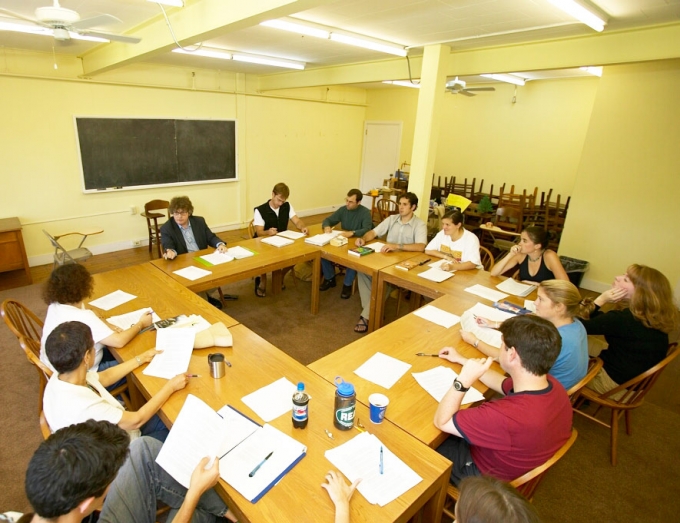
  1. Everyone* in class wants to be there. English majors have often defied the wishes of their parents, chosen happiness over financial gain, and accepted a murky professional future over a straightforward one in order to be in that classroom. The result? People who all (a) read the book, (b) have a lot to say about the book, and (c) come together to create a stimulating discussion.

                               *Except for that person who ended up in Jane Austen class through some scheduling freak-accident.  He will play Words With Friends on his iPad all semester long.

Stock photo of random classroom that essentially encapsulates the English class vibe
Stock photo of random classroom that more or less encapsulates the English class vibe

2. Student camaraderie. “You didn’t start the paper?” “Me either.” “Want to get coffee and edit each others’?” “Um, yes please.”

English majors are in it together. There is no curve, and thus no reason to be competitive or delight in classmates’ failure. We unite in our love of books and reading, but also in our procrastination problems and hate for our professor’s pseudo-British accent and hopelessly ambiguous writing prompts.

If I calculated how much money I spent at Starbs that could have been spent on new books... but I don't have to do math anymore so whatever
Perhaps if I were a math major I would be able to calculate ways to buy less coffee and then save that money for more books…

  1. Cheap books. The most expensive thing an English major will ever have to buy is a $50 used Norton Anthology. Most of the time one has to acquire about five, ten-dollar books and the prof will email you the rest in PDF docs (that is, if this particular literary great happens to be one of the few who understands computers. The majority will come to class bearing stacks of warm print-outs.)

    Lot of this action
    Lot of this action in my backpack
  1. Job applications are a breeze. Writing cover letters is second nature, and English majors come across extremely well on paper. Now, if only you can be equally charming during the interview….
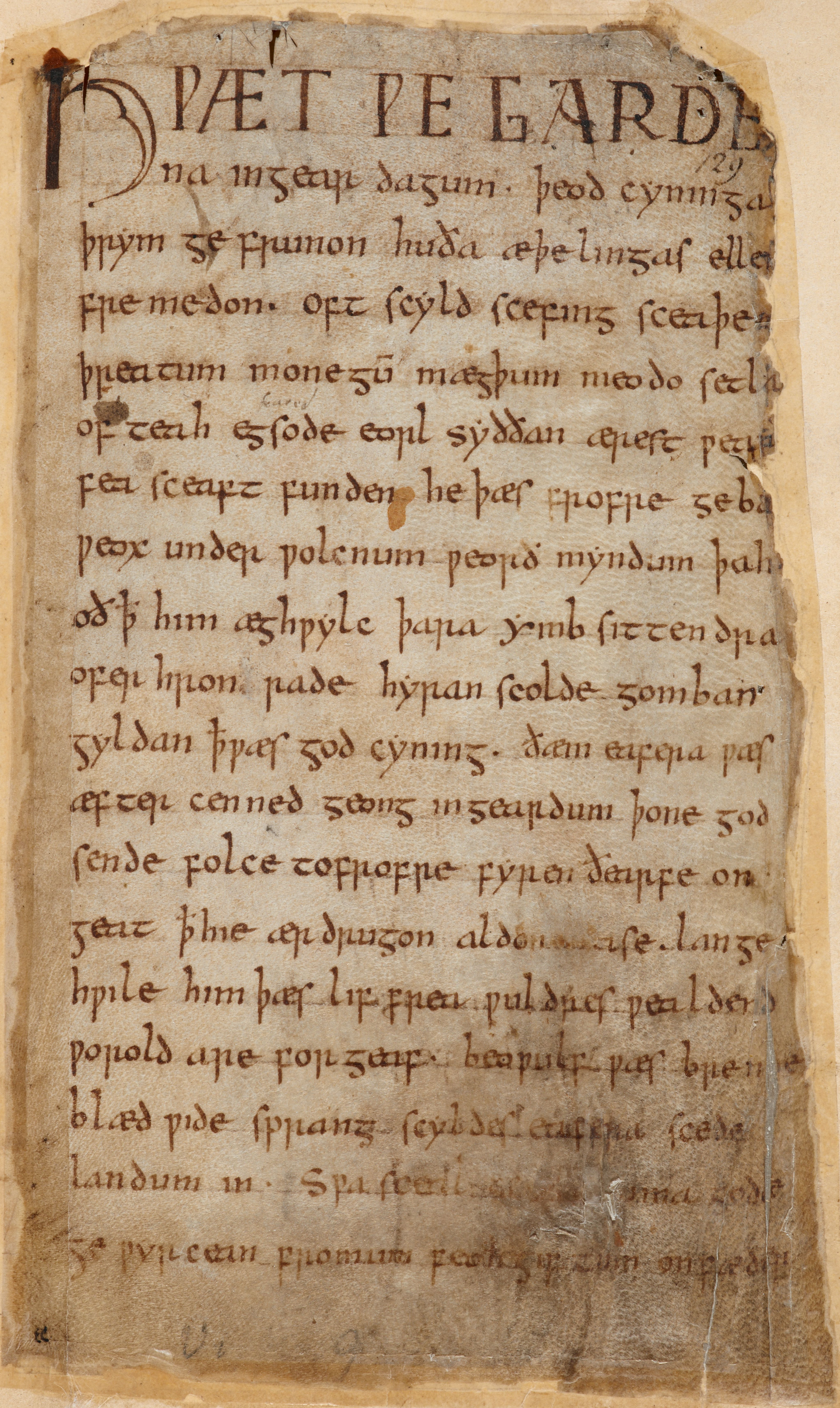
  1. Homework = reading novels and poems. And writing about them. If you are passionate about reading and writing, this can hardly be classified as work. I would be reading and writing anyway, and though I’d prefer there were no due dates or grades (or that I were perusing Harry Potter for the tenth time instead of struggling through Beowulf in Old English), nothing feels better than acing a paper I worked hard on (ahem – slaved over, sacrificing sleep, coffee money, party time…).

    Ahh Beowulf. Where it all began. (Theoretically, I should be able to "read" this by the end of the semester.)
    Beowulf, i.e. where written English began. And now we’re adding words like “amazeballs” and “mansplain” to the OED.
  1. Subjective grading. In contrast to a Calculus test, for example, when an A indicates that you correctly recreated another person’s discovery, an A on an English paper signifies your individual brilliance (at least this is what I tell myself). It distinguishes thoughts that are spot-on, well-organized, and creative enough to impress someone with a PhD in English. And in cases of sub-par papers (and cool professors), there is typically some opportunity to rewrite it or argue for a better grade.

    Such praise leaves me feeling as awesome as if I had been asked out by Matt Duchene (well, almost)
    Nothing quite like a few lines of barely-legible professor praise


    In conclusion, a word from P.G. Wodehouse:

    “There is no surer foundation for a beautiful friendship than a mutual taste in literature.”

“A Book Blog, Liz?” Let Me Explain

Throughout the (almost) twenty-one years I have been able to speak, I have confidently asserted a variety of future plans.

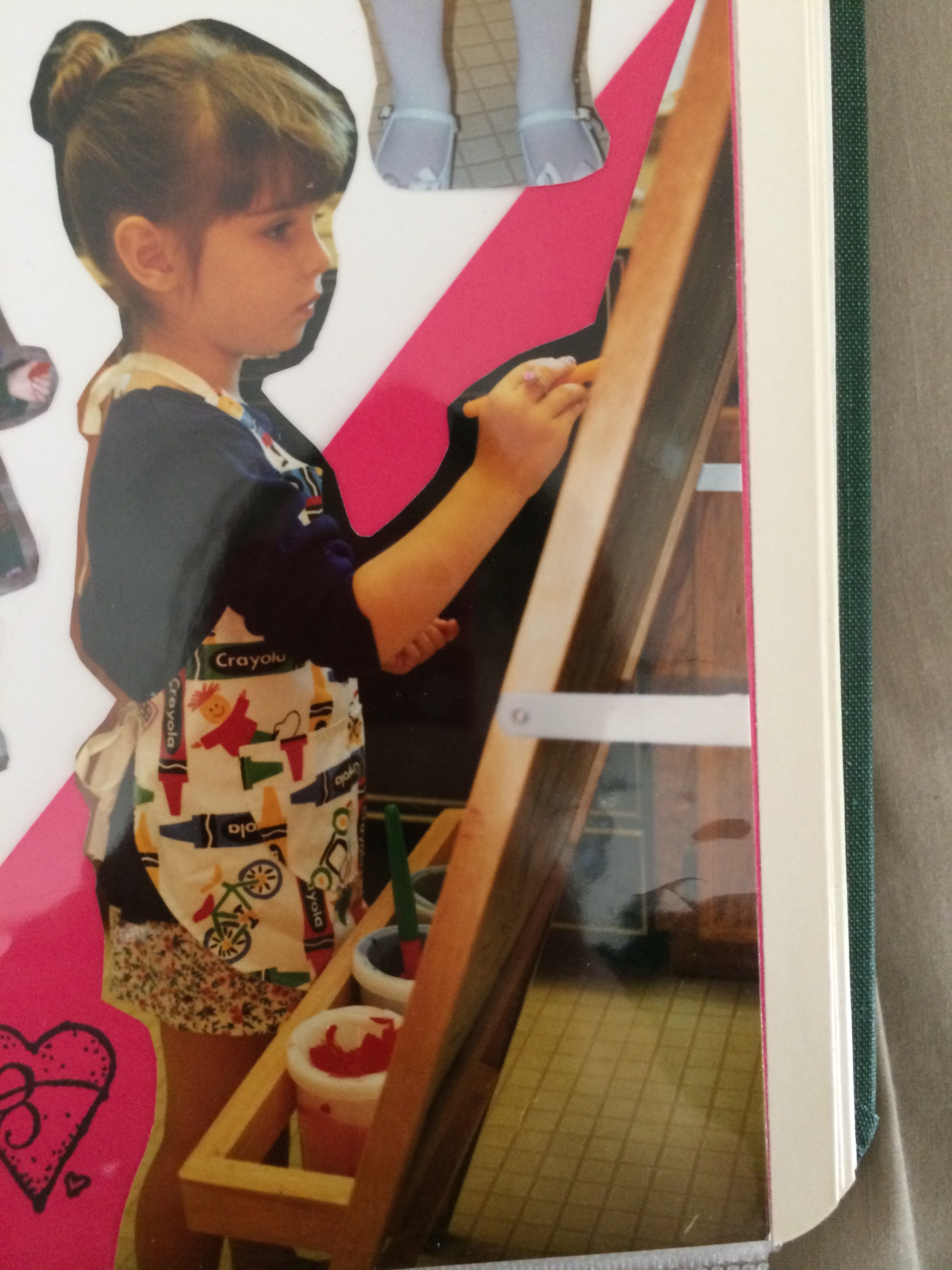
“I’m going to be an artist,” my five-year-old self declared to inquiring adults, proffering pictures of family members with potato bodies, toothpick limbs, and impossibly wide smiles.

Aspiring artist at work

This was followed by a fifteen year period of “I’m going to be doctor,” which I stubbornly insisted upon despite a variety of red flags (including a very real phobia of puking people).

It was only during my first semester of college as a pre-med student that I recognized my folly, surreptitiously skipping many a chemistry class in order to dedicate my efforts to a required lit seminar: “Shakespeare’s Major Tragedies.”

The moment of recognition went something like this: “Shit. There won’t be any lit classes in med school.”

***

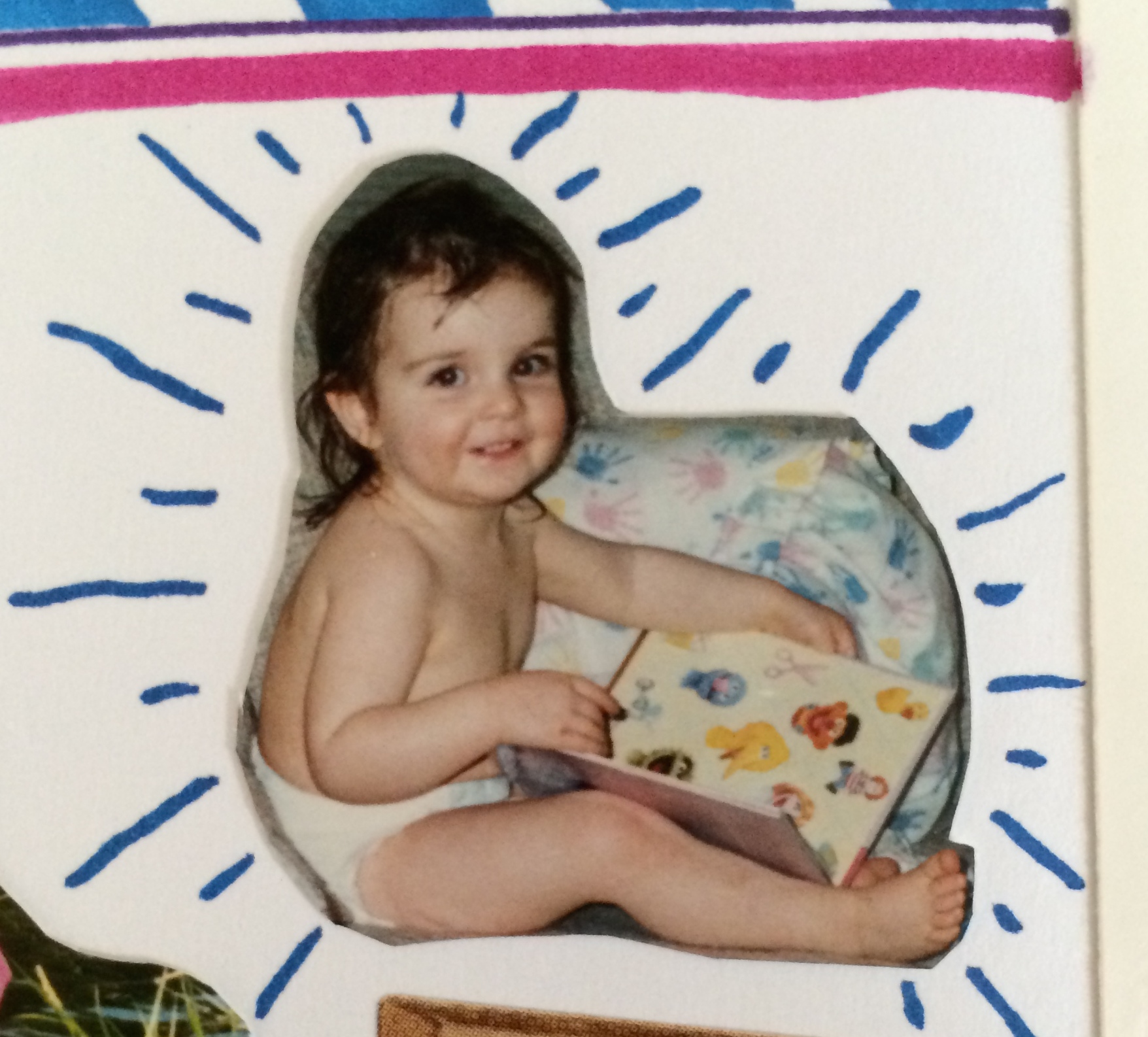
As far back as my memory reaches, books have been an essential part of my existence. Even as an illiterate toddler I carried around piles of books and “read” by reciting the story from memory. (Shout out to my dad for putting in long hours reading through the pile as part of my bedtime ritual.)

Evaluating multiculturalism and postmodernism in Sesame Street
Searching for postmodern themes in Sesame Street

I began reading Harry Potter and the Sorcerer’s Stone in first grade and finished the final words of Harry Potter and the Deathly Hallows the summer before eighth grade (the day it came out, obviously). In the interim, I devoured all varieties of fiction, including the timeless stories of Roald Dahl, the tales of the resourceful feminist Nancy Drew, the blatantly Catholic Chronicles of Narnia, the youth-friendly murder mysteries of Marry Higgins Clark, the obligatory Twilight Saga, and anything and everything by resident boy-expert, Meg Cabot.

With less time to read in high school, I prioritized homework from English class over Calculus and packed as much reading into my summers as possible. One summer I spent an entire month on Jane Eyre and felt hugely accomplished as I crossed out the title on my stained and wrinkled “101 classics to read” list. I then immediately turned to the inviting pink jacket of Tina Fey’s Bossypants to decompress.

Will not be re-reading anytime soon

Now an English major at Notre Dame, my love for books has deepened in the company of brilliant professors, visionary authors, and most of all, talented and thoughtful fellow students. I love every minute of it – okay, except for 4am when I’ve already had 5 coffees and I would rather be talking to people, watching reruns of The Office, or sleeping than railing on Kate Chopin’s misogynistic contemporary critics for 10 double-spaced pages.

***

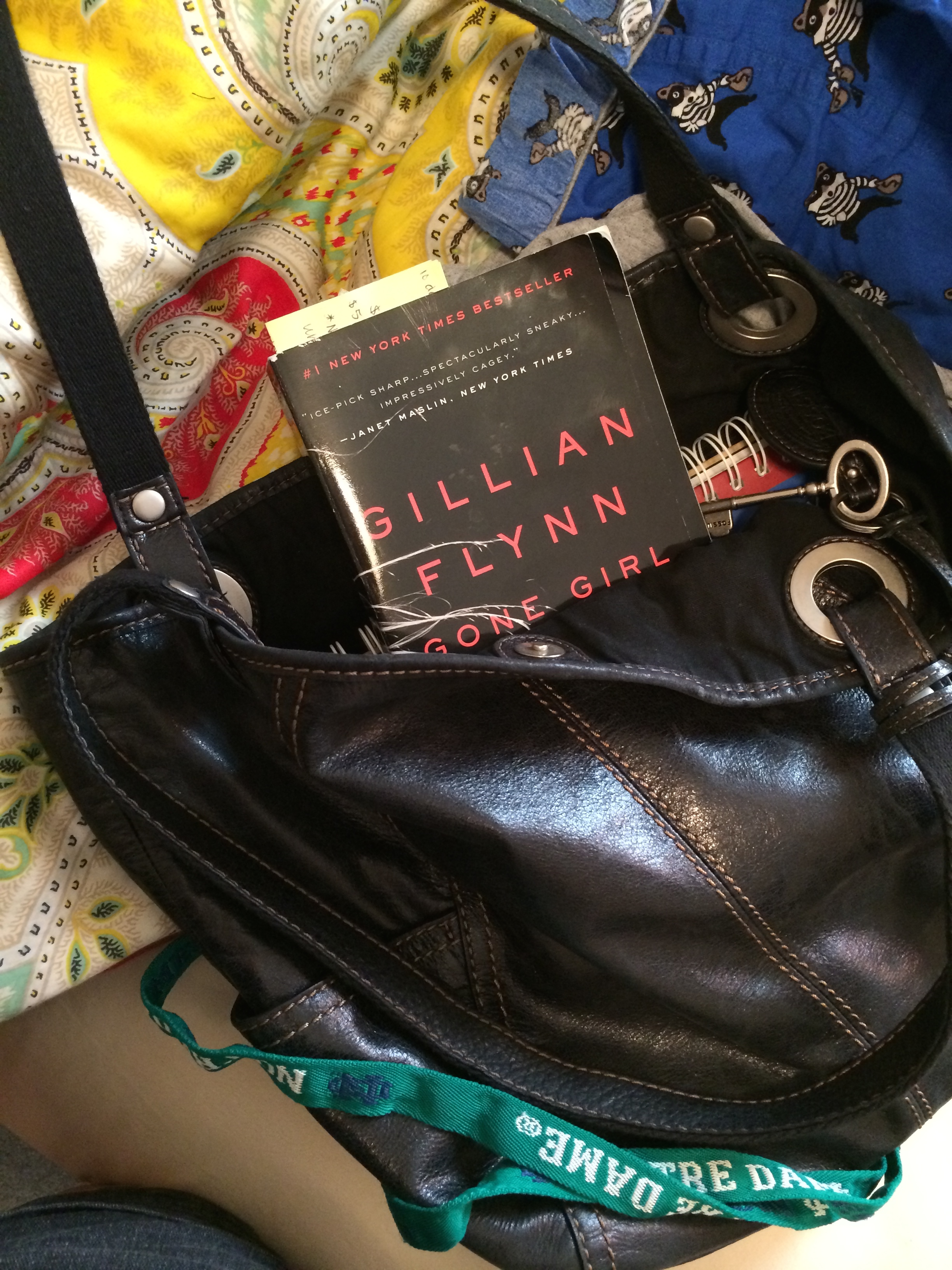
I almost feel physically uncomfortable without a book nearby. I carry books like some people carry miniature purse dogs – a faithful companion for waiting rooms and car rides; a respite from boredom and monotony; a dependable conversation-starter for awkward social moments.

I have a tendency to take my current read to places where I know I’ll never have a chance to open it, like the Starbucks drive-through, my job at Dean Younce Oral and Maxillofacial Surgery, and the library cubicle where I’m supposed to be uber-focused on studying for finals. It’s borderline compulsive.

Today's purse dog
Today’s purse dog

Essentially, this blog is an opportunity to reevaluate, revel in, and share my books. With plans to work in the editing and publishing realm of productive society one day, it will be valuable to practice reviewing books. And though I claim only a nominal understanding of this blogging platform and a limited arsenal of life-experience and material as a twenty-year-old college student, I am giddily excited to start nerding out about books on the internet.